

REVIEWED BY MEMBERS OF MINT
Motivational Interviewing Skills Boot Camp
Change Is Hard
If you’re a personal trainer, on the surface it seems like your job is about goals like how many push-ups you can get your client to do. But the bottom line is that if you’re a fitness professional, your job is all about change . . . and change is hard. And helping other people change is even harder — especially when it’s your staff doing that work, day after day, conversation after conversation.
Across healthcare and social services, organizations rely on professionals to guide people through change and growth: engaging in services, following through on plans, sustaining effort, and adapting over time.
Most agencies already know what works in principle.
They’ve invested in Motivational Interviewing training.
They’ve sent staff to workshops.
Many have shelves—or shared drives—filled with MI resources, including earlier editions of Miller & Rollnick.
And yet . . .
Despite good intentions and solid theoretical knowledge, many change conversations still stall.
Clients disengage.
Follow-through drops off.
Staff feel frustrated, ineffective, or quietly burned out.
Not because MI doesn’t work.
And not because your staff don’t care or aren’t capable.
But because knowing MI and doing MI well are not the same thing.
The Real Problem Most Organizations Face with MI
Most professionals today don’t need an introduction to MI.
They can describe the spirit of MI, know OARS, and some may even be able to list the four MI tasks.
But when they’re in a real conversation — under time pressure, with ambivalence, pushback, or emotional complexity — something else happens, and they:
Slide into old habits.
Miss change talk—or don’t know how to strengthen it.
Move too quickly into planning.
Confuse affirmation with praise.
Feel uncertain about how directive MI can or should be.
It’s a practice problem.
MI is famously simple but not easy. And as Miller, Rollnick, and Moyers have asserted: MI proficiency requires repeated, structured, feedback-informed practice — not just workshops, not just reading, and not just good intentions.
Yet most organizations have no practical and time efficient way to provide that kind of practice at scale.
Why Getting Better at Motivational Interviewing Makes Such a Crucial Difference
Too many organizations assume that stalled change is a problem of client willpower—or that it’s a “motivation issue” the client needs to solve on their own. But ineffective change conversations take a toll on staff as well.
When professionals repeatedly have unproductive conversations with clients, their energy and focus begin to drain. They start to disengage themselves, bracing for the next difficult interaction. Strain accumulates and over time can affect the entire team.
That strain doesn’t stay contained within a single conversation. Research on professional burnout, emotional exhaustion, and chronic workplace stress shows that repeated frustrating interactions keep the nervous system in a heightened state, impairing emotional regulation, concentration, and cognitive flexibility. Over time, this weakens resilience, erodes empathy, and can even affect physical health.
Across healthcare, social services, education, and leadership, studies consistently show that unresolved friction in change conversations contributes to higher burnout, lower job satisfaction, and diminished effectiveness—not only for staff, but for the people they serve.
But when professionals learn how to guide conversations in ways that draw out a client’s own motivation, everything shifts.
Staff think more clearly. They listen more precisely. They respond with greater purpose and confidence. Instead of feeling responsible for motivating others, they experience themselves as capable of reliably guiding change.
And instead of ending the day replaying stalled conversations or dreading the next one, staff leave knowing they helped someone take a real step forward—because it came from the client, not from pressure or persuasion.
Why the 4th Edition of MI Raises the Bar and Reveals the Gap
The 4th edition of Motivational Interviewing was not written to add complexity. As Miller and Rollnick explain, it was written to distill what is essential.
Compared to the 3rd edition, it clarifies MI as:
A way of talking with people about change and growth—not a set of techniques
A style that accompanies people through ongoing change, not just preparation for change
An approach used by a wide range of helping professionals—not only therapists
A practice that is directional, strategic, and intentional, while still honoring autonomy
It also updates key language, sharpens distinctions (such as affirmation versus praise), and emphasizes cultivating change talk while softening sustain talk. MI “processes” are now more plainly called tasks, reinforcing that MI is something you do moment by moment in conversation.
Just as important, the 4th edition explicitly elevates what earlier editions implied: MI skill develops through deliberate practice and learning communities—not through reading or workshops alone.
And this is where many organizations now find themselves stuck.
Most staff have been trained under earlier editions or workshop-based models. They may recognize that MI has evolved, but they haven’t had structured opportunities to practice MI as it is now defined. Reading a clearer book—even a better one—does not solve that problem.
Workshops still introduce concepts.
Books still clarify principles.
Neither reliably builds conversational fluency under real-world conditions.
As Miller, Rollnick, and Moyers have long emphasized, MI is simple but not easy. The 4th edition makes MI clearer—but it also makes the practice gap more visible. Without a way to rehearse directional use of OARS, work skillfully with change and sustain talk, and stay grounded in MI spirit under pressure, staff remain caught between knowing MI and being able to use it effectively.
The result is familiar: good intentions, uneven practice, and frustration on both sides of the conversation.
Introducing the Motivational Interviewing Boot Camp
The Motivational Interviewing Boot Camp was designed specifically to close the knowing–doing gap—and to do so in alignment with the 4th edition of MI.
This is not an introductory MI course.
It assumes prior exposure and basic familiarity.
Instead, it provides what most organizations lack:
a structured, scaffolded, app-based practice environment that allows staff to translate MI knowledge into usable skill.
Over 14 modules, participants engage in deliberate, sequenced practice that reflects how MI proficiency actually develops—through use, reflection, and repetition.
What Makes This Boot Camp Different
In just minutes a day for 14 modules, the Motivational Interviewing Boot Camp gives staff structured, science-backed process for helping people move toward change in a way that’s easier, more collaborative, and far more effective than you may have thought possible.
Staff won’t just “get better at asking questions.”
They’ll learn how to listen for the language of change, respond in ways that strengthen commitment, and keep the conversation moving forward—while honoring the other person’s autonomy and the organization’s values.
This Boot Camp helps staff:
Clarify the outcome that really matters—so conversations have direction without turning into persuasion.
Shift from “I need to convince you” to “we’re exploring your path forward”—transforming discord into readiness.
Spot what’s already working—no matter how small—and amplify it to build momentum.
Use OARS skills (Open questions, Affirmations, Reflections, Summaries) to deepen engagement and build trust.
Draw out ideas and strategies from the other person so they own the change plan.
Help people mentally rehearse success—and identify the next step that feels doable, not overwhelming.
Whether staff work with clients, patients, students, or team members, this process can help you create better outcomes with less struggle—while protecting staff energy, strengthening professional impact, and helping organizations deliver change that actually lasts.
CE CREDITS PENDING

The PACE, OARS, and Tasks Framework
Motivational Interviewing is built around three core pillars: PACE, OARS, and the Four MI Tasks—a practical, structured approach to guiding change conversations in real time.
These aren’t just a set of tips. Together, they form a complete framework that shifts how staff show up, how they respond in the moment, and how the conversation moves forward.
PACE defines the spirit staff bring to every conversation:
Partnership – working alongside the person as an equal.
Acceptance – honoring their autonomy, worth, and perspective.
Compassion – keeping their best interests at the heart of the conversation.
Evocation – drawing out their own ideas and reasons for change.
OARS gives staff the essential skills to bring PACE to life:
Open Questions to invite exploration.
Affirmations to reinforce strengths and progress.
Reflections to deepen understanding and highlight change talk.
Summaries to organize ideas and move toward decisions.
Finally, the Four MI Tasks provide the roadmap for where the conversation goes:
Engaging – building trust and connection.
Focusing – clarifying what matters most.
Evoking – drawing out motivation and readiness.
Planning – moving from ideas into action.
Together, these elements help staff:
Stay future-focused instead of recycling frustration about what’s not working.
Spot and amplify moments of motivation, even when they’re small or fleeting.
Turn good intentions into realistic, self-directed next steps.
Build conversations where people feel heard, respected, and empowered to act.
Through PACE, OARS, and the Four Tasks, staff stop defaulting to advice-giving or persuasion—and start guiding conversations in ways that are consistent, effective, and aligned with both professional values and organizational standards.
Faculty

Dr. David Mee-Lee
IWE Co-founder
Clinical Faculty

Dr. Deborah Teplow
IWE Co-founder
Training Director
What People Are Saying About The Motivational Interviewing Boot Camp
-
I was very impressed with the interactive components of the module which enhance learning. I frequently wonder about the effectiveness of online (self-learning) of MI. This course offers a lot of practice... that can easily assist in learning MI and building MI skills.
Sandra R. Brown, DNP, APRN
-
This course gave me in-depth training in motivational interviewing that included abundant practice on critical skills that are making a difference in how I practice. The course goes way beyond anything we got in our graduate training and fills in a big gap that I'm sure a lot of clinicians have.
Julie S, RN MFCC
-
... valuable for individuals with basic counseling skills and for those with more advanced skills... will capture the interest of professionals who have the basic skills but who want additional training to gain competency and to be able to provide supervision.
Tamara Bradham Atkinson, MSW, LCSW
Why This Boot Camp Will Do More Than Just Improve Conversations — It Will Change the Way Your Organization Helps People
MI isn’t about memorizing clever responses or following a rigid script. It’s about transforming how you approach the moments that matter—so you can stay collaborative, listen deeply, and guide people toward change while honoring their autonomy.
With values-based Motivational Interviewing, staff don’t just “get better at listening.” They reshape conversations so that they become a catalyst for action—conversations where the other person feels respected, engaged, and ready to take their own next step. That shift has measurable, lasting benefits.
Research shows that effective MI skills can:
Protect your professional energy – Staying collaborative instead of confrontational reduces stress and preserves focus for the work that matters most.
Boost cognitive performance – Skilled MI practitioners engage brain regions linked to empathy, regulation, and problem-solving, helping them respond more effectively under pressure.
Strengthen relationships – Conversations grounded in partnership and respect deepen trust and rapport across all settings—from healthcare to coaching to leadership.
Reduce burnout and emotional fatigue – When you stop replaying stalled interactions or worrying about “what to say next,” you reclaim both mental and emotional space.
The PACE, OARS, and Tasks framework helps staff build these skills in real time—whether they’re working with clients, patients, students, or colleagues.
Through this Boot Camp, staff won’t focus on persuading people to change. They’ll learn a wholly different way to approach change conversations—one that protects what matters most: staff integrity, the other person’s agency, and the shared goal of meaningful progress.
The ripple effects are real. This process:
Aligns your work with your core values as a helper.
Breaks cycles of pushback, defensiveness, or disengagement.
Builds staff’s trust in their ability to guide change without pressure.
Opens creative, forward-focused dialogue where old patterns stalled progress.
Gives staff lived proof that you can create momentum without force.
This isn’t about “getting better at talking to people.” It’s about becoming the kind of professional who brings curiosity, clarity, and compassion to even the most challenging conversations about change.
This Boot Camp is where that begins.
How This Boot Camp Works
This is an immersive experience designed for real conversations with real people—because it focuses on practical application, not abstract theory.
The Motivational Interviewing Boot Camp is a robust, skill-building program that will transform staff sees their role in helping others—and how they show up in the moments when change feels stuck.
They’ll walk away with a new sense of self: not as someone frustrated by discord, worn down by stalled progress, or drained from trying to convince people—but as someone who can guide conversations that spark motivation, unlock commitment, and lead to action. They’ll see themselves as grounded, capable, and aligned with what matters—able to respond effectively even when conversations get complicated.
And this Boot Camp is designed to make that transformation fast, focused, and sustainable.
Our interactive learning platform is a training hub, where they wi’ll find all lessons, activities, and skill-building exercises in one place.
Each module gives staff small, manageable steps that fit into their day:
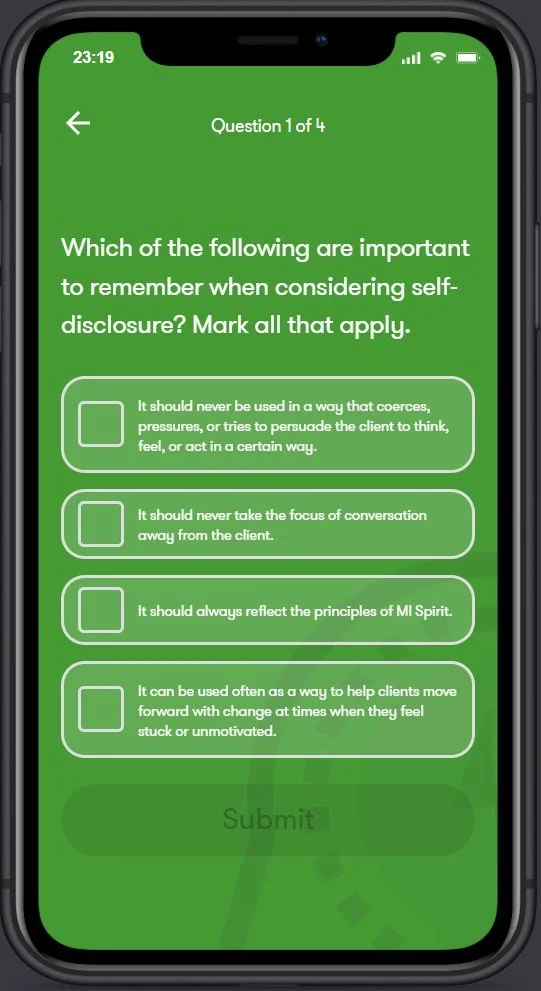
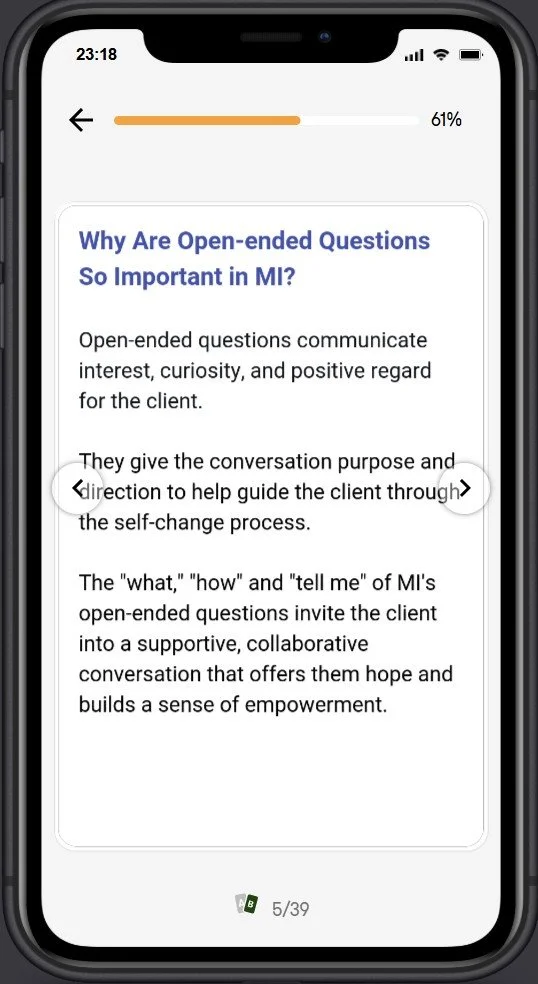
Flashcard-based daily lessons to master each concept in minutes.
Practice quizzes that give immediate feedback on right and wrong answers—so they’ll learn from both.
Audio demonstrations so they can hear skills in action and model them in their own style.
Reflection exercises to assess and strengthen their MI skills.
Examples from real-world scenarios to bridge the gap between learning and doing.
What You’ll Get
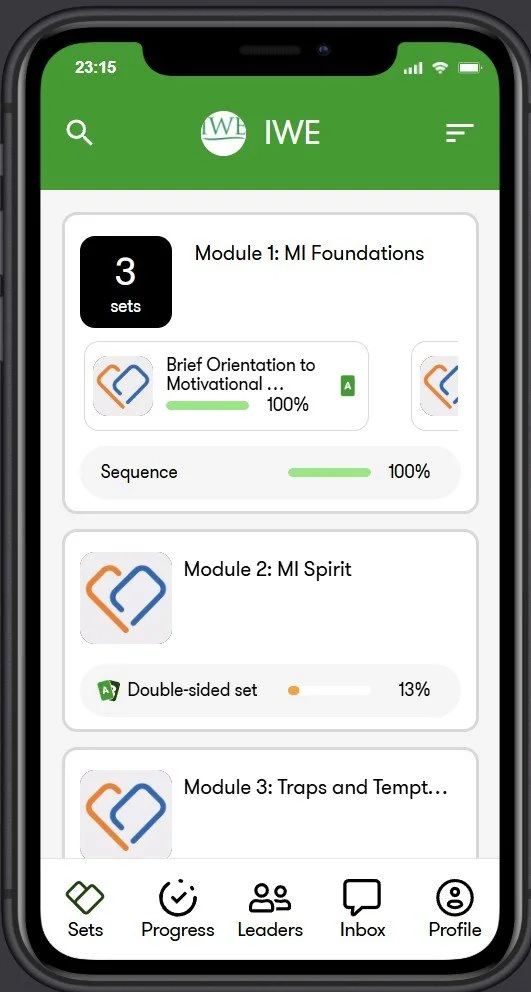
Here’s a glimpse inside the course. Each module builds step by step, giving you the skills, tools, and confidence to create conversations that actually spark change.
Module 1: MI Foundations
Unit 1: Brief Orientation to Motivational Interviewing
Unit 2: How Change Works
Unit 3: How People Talk About Change
Module 2: MI Spirit
Unit 1: MI Spirit
Module 3: Traps and Temptations to Avoid
Unit 1: Traps and Temptations to Avoid
Module 4: Roadblocks to Change
Unit 1: Roadblocks to Change
Module 5: MI Skills
Unit 1: MI Skill #1: Open-Ended Questions
Unit 2: MI Skill #2: Affirmations
Unit 3: MI Skill #3: Reflections
Unit 4: MI Skill #4: Summaries
Module 6: MI Tasks
Unit 1: MI Task #1: Engaging
Unit 2: MI Task #2: Focusing
Unit 3: MI Task #3: Evoking
Unit 4: MI Task #4: Planning
Each unit ends with a certificate of completion that your staff can add to their professional toolkit documenting their progress. By the time they’ve worked through all the modules, they won’t just know about Motivational Interviewing. They’ll be able to use it fluently in real conversations.
CE CREDITS PENDING
Who Should Enroll?
This Boot Camp is for organizations that:
Already value Motivational Interviewing
Want staff to use MI effectively, not just know it
Recognize that workshops alone aren’t enough
Care about client engagement and staff sustainability
It is not for organizations looking for scripts, shortcuts, or compliance-based communication tools.
Frequently Asked Questions
Still have questions? Take a look at the FAQ or reach out anytime.
-
Motivational Interviewing is an evidence-based, collaborative way of talking with people about change and growth that strengthens their own motivation and commitment. Rather than persuading, directing, or fixing, MI helps professionals guide conversations so clients, patients, or participants articulate their own reasons for change and take ownership of next steps.
MI is widely used across healthcare, behavioral health, education, social services, coaching, leadership, and supervision. It is not a script or a technique to apply occasionally—it is a way of working in conversation that supports engagement, follow-through, and sustained change.
-
Most MI trainings focus on exposure—introducing concepts through workshops, lectures, or reading. This Boot Camp focuses on practice.
The Motivational Interviewing Skills Boot Camp is designed to help staff translate what they already know about MI into something they can use reliably in real conversations. It provides structured, scaffolded, repeated practice aligned with the 4th edition of MI—something most organizations do not have in place.
This is not an introduction to MI. It is a practice environment for building conversational fluency.
-
The Boot Camp consists of 14 short modules, designed to be completed in minutes per day, not hours at a time.
Most participants complete the full program over 2–3 weeks, depending on pacing. Because the content is app-based and modular, staff can integrate it into their regular workday without disrupting service delivery.
-
No—it complements them.
Workshops and books are valuable for introducing MI concepts. The Boot Camp provides what typically comes next: ongoing, structured practice that helps staff use MI effectively after the workshop is over.
Many organizations use the Boot Camp as a follow-up to training, a refresher, or a way to create greater consistency across teams.
-
Organizations use the Boot Camp to support:
Improved client engagement and follow-through
Greater consistency in MI practice across staff
Increased staff confidence and reduced frustration
Lower burnout associated with stalled change conversations
Stronger alignment with evidence-based practice
The goal is not perfection—it’s reliable, effective conversations that move people forward.
Sign Up Now: Start Now, Go at Your Own Pace
Pay in full or use our interest-free payment plan that makes it easy to get the training you need right now.

Regular Tuition
$199

ACE Member Discount
$169

Discount for Groups of 3+
(Use Discount Code: “GROUP”)